Seven nights on the Silk Road, no plans, one notebook
From Tashkent to Bukhara by slow train, with nothing booked and a pen that ran out somewhere near Samarkand.
Marisol Ferreira
Samarkand, Uzbekistan
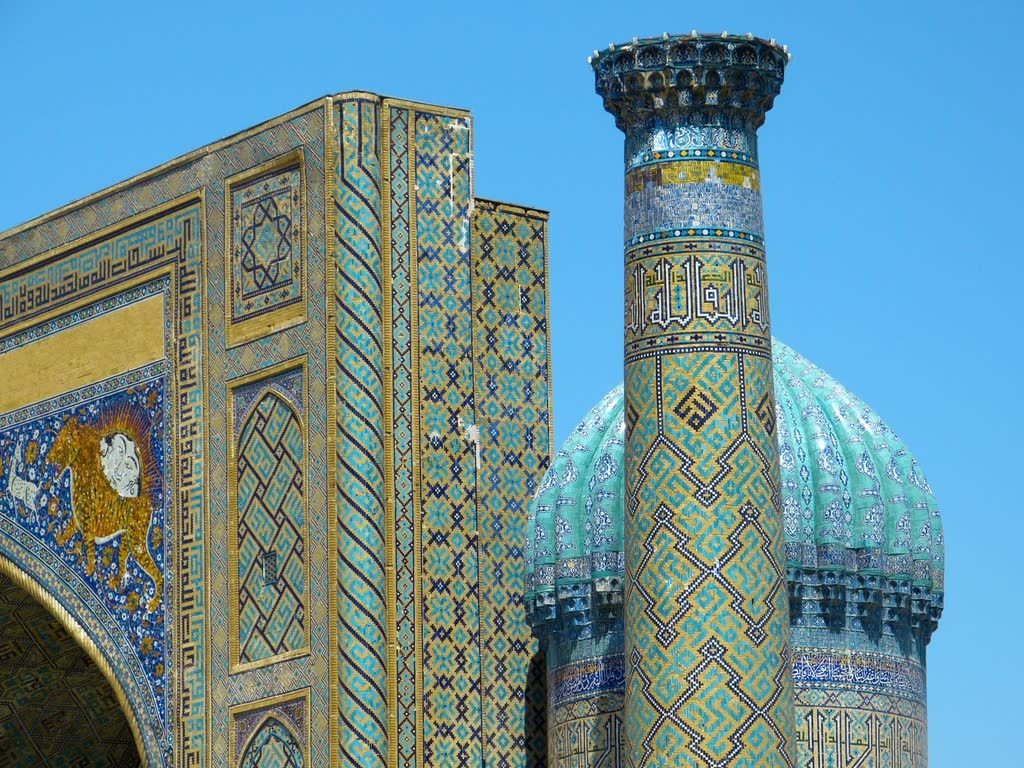
The Afrosiyob leaves Tashkent at seven in the morning, and by half past I had already broken my only rule. I had promised myself not to look at the map. I was going to let the country arrive in its own order, the way it would if I had walked here in the twelfth century with a donkey and a headache. Instead I found myself pressed against the window, tracing the line of the Zarafshan with a finger, trying to guess which smudge on the horizon would turn into Samarkand.
It turns out you cannot guess. Samarkand does not appear; it interrupts. One moment there is a cotton field and a man on a motorbike carrying an entire door, and the next the Registan is standing at the end of the street, three madrasas leaning towards each other like people sharing a secret, every surface tiled in a blue that makes the sky look under-rehearsed. I sat on the steps for two hours. I wrote nothing. The notebook stayed closed on my knee, warm from the sun, and that felt correct.
Without a plan, days organise themselves around bread. In the old town there is a tandir bakery where the loaves come out stamped with a pattern of pinpricks, and the woman who runs it will not let you leave with only one. So you carry two through the bazaar, past pyramids of dried apricots and a man selling nothing but knives, and you eat one of them on a bench outside the Bibi-Khanym mosque while a wedding party photographs itself against the gate. Nobody minds. Everybody, in fact, waves.
Samarkand does not appear; it interrupts.
The train to Bukhara is slower and older and better. It has curtains. It has a conductor who brings green tea in glasses that rattle in tin holders, and a carriage of grandmothers who found my attempt at Uzbek so funny that one of them wrote out the numbers one to ten on the back of my ticket, in pencil, with drawings. I still have it. It is the best map I own.
Bukhara at dusk is the colour of the bread. Everything is mud brick and low light, and the domes of the trading halls are the only thing that catches the last sun. I found a rooftop where a boy of about twelve was flying a kite made from a plastic bag, and he let me hold the string, and we stood there not talking while the call to prayer went up from four directions at once and the swallows did something in the air that I have not got words for yet. The pen ran out that evening. I did not replace it.
The pen ran out that evening. I did not replace it.
I am aware this is the kind of story where the writer pretends the lack of plan was a philosophy. It was not. I was tired and a little frightened and I did not want to make decisions. But the thing about the Silk Road is that it has been making decisions for people for two thousand years. You get on the train. The train knows.