Two days downstream on the slow boat
Huay Xai to Luang Prabang on a long wooden boat with a hundred strangers, a card game, and a river the colour of milky tea.
Dev Ramaswamy
Luang Prabang, Laos
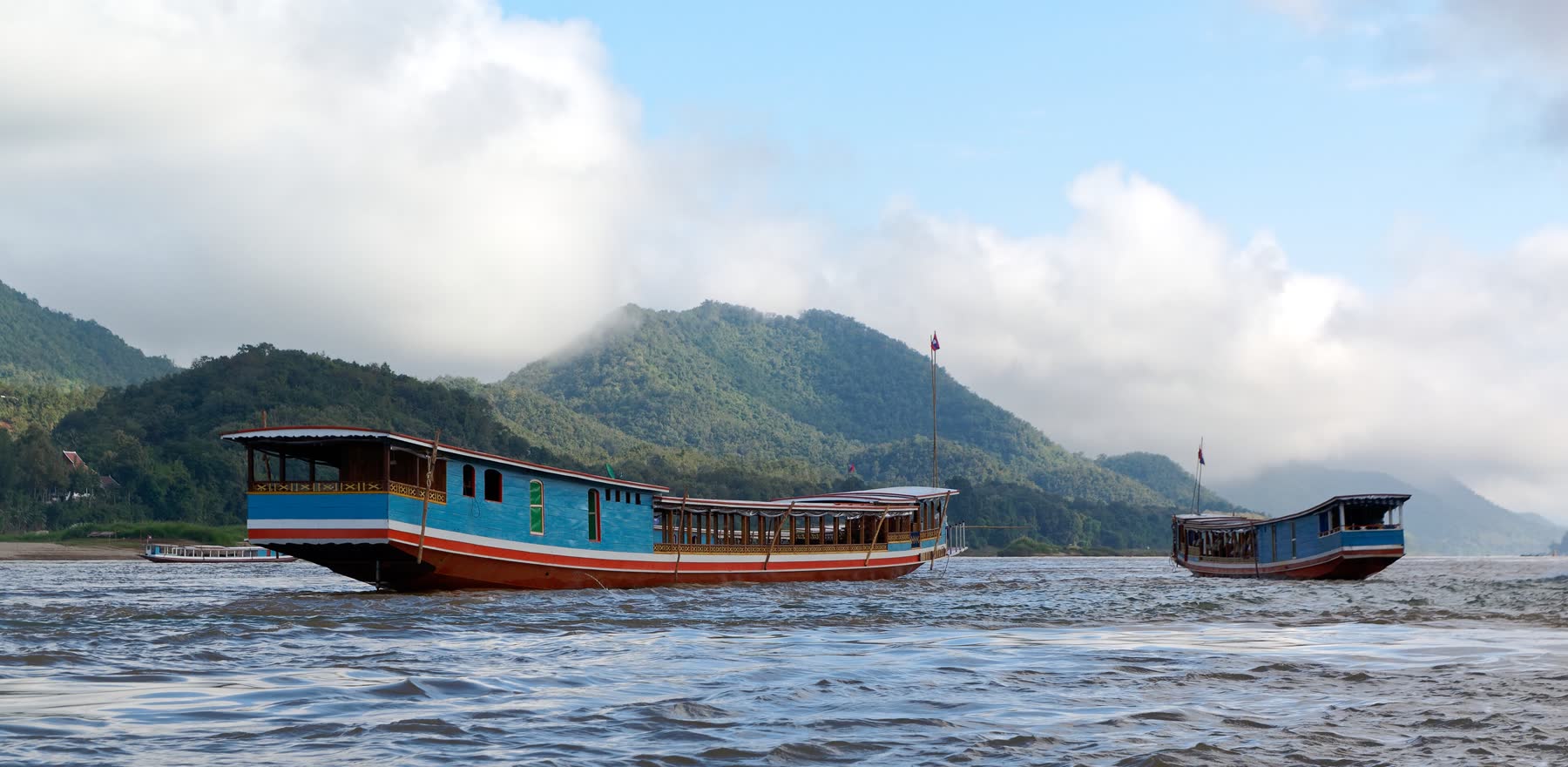
The boat is long and low and made of teak, and the seats are recycled from a minibus and bolted to the deck in rows that do not quite line up, and by nine in the morning at Huay Xai there are ninety people on it and the water is eight inches below the gunwale. Then the engine starts, an unmuffled diesel that lives under the floor at the back and sounds like a lawnmower having an argument with a boat, and we push out into the Mekong, and the argument becomes the weather for two days.
The Mekong here is broad and brown and fast, threaded with rocks that the captain reads the way you read a face. On either side the hills come straight down to the water, forested to the top, with here and there a village of stilt houses and a strip of vegetable gardens on the silt, and water buffalo standing in the shallows like furniture. Children run down the banks to wave. Everybody waves back. It is not possible not to.
By the second hour the boat has sorted itself into a society. There are the sleepers, at the back by the engine, who have accepted the noise as a lullaby. There are the readers. There is a card school of Dutch and Argentinian and Lao teenagers that will run, with substitutions, until Luang Prabang. There is a monk in orange who sits by the prow and looks at the river the whole way and never once takes out a phone. I sat near him. I did not manage the same.
A lawnmower having an argument with a boat.
We stopped the night at Pakbeng, a village that exists because the boat stops there, strung along a hill above the landing. I ate laap and sticky rice at a table on a balcony, with a beer that cost less than the tip, and went to bed at nine because there is nothing else to do and that is the point. At five in the morning the river was under a skin of mist and an elephant was drinking from it on the opposite bank. I mention this only because it happened.
The second day is longer and quieter. People stop talking. The river widens, the hills get taller and closer, limestone karsts start to lift out of the forest like teeth, and the light goes golden and then orange and then a colour I associate with the inside of a mango. At the Pak Ou caves the boat slows and the monk stands up for the first time and looks, and then sits down again, and I understood that he had been waiting two days to see them and that this was, for him, the whole trip.
The boat was already just a boat again, waiting for tomorrow's strangers.
Luang Prabang arrived at dusk, a peninsula of temples and French shutters at the junction of two rivers, and the boat tied up below a set of steps and ninety people stood up at once and the society dissolved. The card game ended. The monk was gone before I saw him go. I climbed the steps with my bag and my sunburn and turned round at the top, and the boat was already just a boat again, long and low, riding eight inches out of the water, waiting for tomorrow's strangers.